Showing posts with label Reading. Show all posts

Thursday, May 2, 2019

Week 15: Reading Notes Part B (Brother's Grimm Unit)

Brothers Grimm: Eve's Unequal Children

This story is part of the Brothers Grimm unit. Story source: The Grimm Brothers' Children's and Household Tales translated by D. L. Ashliman (1998-2013).

  • Adam and Eve were working and doing chores 
  • Eve brought a child into the world every year
    • (some were good-looking and some were ugly)
  • The ugly children were not allowed to be seen 
    • The ugly children, however, were not to let themselves be seen. She hid one of them beneath the hay, another in the attic, the third in the straw, the fourth in the stove, the fifth in the cellar, the sixth under a tub, the seventh beneath the wine barrel, the eighth under an old pelt, the ninth and tenth beneath the cloth from which she made their clothes, and the eleventh and twelfth under the leather from which she cut their shoes.
  • One day the Lord came knocking on their door 
  • Eve was hesitant to show her children to him
  • But, nonetheless the Lord blessed them all 
    • "You shall be a peasant," to the second, "You a fisherman," to the third, "You a smith," to the fourth, "You a tanner," to the fifth, "You a weaver," to the sixth, "You a shoemaker," to the seventh, "You a tailor," to the eighth, "You a potter," to the ninth, "You a teamster," to the tenth, "You a sailor," to the eleventh, "You a messenger," to the twelfth, "You a household servant, all the days of your life."
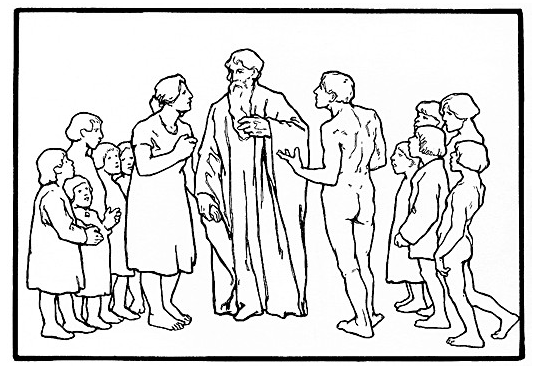
(Illustration by Otto)

Wednesday, May 1, 2019

Week 15: Reading Notes Part A (Brother Grimm)

Brother Grimm: Little Red Cap

This story is part of the Brothers Grimm unit. Story source: The Grimm Brothers' Children's and Household Tales translated by D. L. Ashliman (1998-2013).


  • Little Red Cap is little girl liked by everyone 
  • She is closest with her grandmother
  • One day, Little Red Cap's mother told Little Red Cap that she needed to take some cake and a bottle of wine to her grandmother because she was very weak 
  • Her mother emphasized to Little Red to stay on the path!
  • Her grandmother lived out in the woods a half hour away 
  • A wolf approached her and she didn't know he was a dangerous animal 
  • The wolf walked with Little Red Cap for awhile and asked where she was going and what she was doing
  • Little Red explained that she was going to her grandmother's 
  • The wolf got Little Red distracted
  • He pointed out all the beautiful flowers and Little Red thought to herself how much her grandmother would appreciate them 
  • She strayed from the path to pick some flowers 
  • While Little Red was picking flowers the wolf headed straight for Grandmothers
  • The wolf approached the house and said he was Little Red 
  • Then he went inside and gobbled her up and put her clothes on 
  • Oh, grandmother, what big ears you have!"

    "All the better to hear you with."

    "Oh, grandmother, what big eyes you have!"

    "All the better to see you with."

    "Oh, grandmother, what big hands you have!"

    "All the better to grab you with!"

    "Oh, grandmother, what a horribly big mouth you have!"

    "All the better to eat you with!"
  • The wolf then ate up Little Red 
  • Soon after a huntsman heard big snoring at the Grandmother's house he came and said I have been hunting you for a long time 
  • Instead of shooting the wolf he cut his belly with scissors and out popped little red and her grandmother 
Little Red Postage Stamp

Wednesday, April 24, 2019

Week 14: Reading Notes (Italian Popular Tales Part A)


Zelinda and the Monster

This story is part of the Italian Popular Tales unit. Story source: Italian Popular Tales by Thomas Frederick Crane (1885).

  • This is the Italian version of Beauty and the Beast 
  • A poor man had three daughters 
  • The youngest was the most civil and the fairest 
  • Every January the man would travel to a fair in a neighboring town 
  • One daughter asked for a dress, one asked for a shawl, and Zelinda asked for a rose 
  • The man easily found the dress and shawl, but had to leave the fair to look for a rose for his dear Zelinda 
  • He came upon a huge castle
  • There was every kind of flower you could think of 
  • The house looked dead and vacant, so he reached and picked a rose 
  • All of a sudden, flames came from the Earth and a scary dragon shaped figure came from the castle 
  • The monster wanted to kill then man, but instead settled for allowing him to return home and bring back the daughter that wanted the rose 
  • Zelinda understood what had to be done and traveled back to the Monster with her father 
  • They arrived and were treated very well, they were able to stay and the castle and they were provided a huge breakfast before the father had to leave Zelinda under the Monster's power 
  • Once Zelinda's father left, the Monster was so nice to Zelinda. He treated her like a queen and asked if she would marry him 
  • Zelinda couldn't commit because of the way the monster looked
  • One day the monster called out to Zelinda in a haste 
  • He said, "Listen, Zelinda: if you do not consent to marry me, it is fated that your father must die. He is ill and near the end of his life, and you will not be able even to see him again. See whether I am telling you the truth."
  • He began drawing out an enchanted mirror and there she saw her father on his deathbed 
  • Without hesitation Zelinda promised to marry the monster and be a loyal wife 
  • She wanted to hug her father one last time 
  • After she said those words, the monster turned into a handsome young prince
[Crane did not translate the rest of the story but just summarized it as follows: Zelinda and her husband strive to obtain his parents' consent to his marriage. They refuse and the young couple run away from the royal palace and fall into the power of an ogre and his wife, from whom they at last escape.]
(Zelinda, her father, and the Monster)

Thursday, April 18, 2019

Week 13: Reading Notes (Looking Glass Part B)

Looking-Glass: Queen Alice

This story is part of the Looking-Glass unit. Story source: Through the Looking-Glass, and What Alice Found There by Lewis Carroll (1871).

  • Alice is now a queen 
  • She walked around rather stiffly to get use to the crown, she was afraid it would fall off 
  • The White Queen and The Red Queen sat on either sides of Alice 
  • She was very curious to how they came to be queens, but knew that wouldn't be a civil conversation 
  • Alice isn't as intimidated as I would assume she would be with the queens
  • She speaks out of turn and then The Red Queen yells at her, but she doesn't let that stop from her from being heard
  • She is stuck in an impossible situation 
  • The Queens invite each other to Alice's party 
  • Alice doesn't know she's having a party in the first place 
  • The Queens go on asking impossible and difficult questions 
  • For instance, "what's one plus one plus one plus one plus one plus one plus one plus one plus one"
  • They go on to talk about the differences in wonderland and where Alice is from 
  • In wonderland they talk about days in sets, like the last sets of tuesdays' weather has been bad
  • Whereas Alice takes a day at a time 
  • Alice's time with the Queens is full of riddles and quizzes and lessons

(Illustration by John Tenniel)

Wednesday, April 17, 2019

Week 13: Reading Notes (Looking Glass Part A)

This story is part of the Looking-Glass unit. Story source: Through the Looking-Glass, and What Alice Found There by Lewis Carroll (1871).

Tweedledee and Tweedledum


  • Alice was walking and talking to herself and stumbles upon two fat little men
  • She knew their names because they had DUM and DEE embroidered on their clothes
  • She kept staring and looking for the word TWEEDLE embroidered 
  • The two stood as still as statues 
  • Alice kept thinking about a song she knew; It referred to Tweedledum and Tweedledee
  • The two argue all the time and the song Alice knew referenced that 
  • The boys reminded Alice of little schoolboys \
  • She just needed directions to get out of the forest 
  • The boys grinned and said that she needed to properly shake their hands and greet them first 
  • Alice not wanting to upset either of them, shook their hands at the same time 
  • As soon as she shook their hands she found herself dancing with them, spinning in circles
  • The boys were definitely out of shape and couldn't dance for too long 
  • The boys avoided Alice's question on hot get out of the forest and wanted to read her poetry instead


(tweedledee and tweedledum)

Thursday, April 11, 2019

Week 12: Alice in Wonderland Reading Part B

Wonderland: A Mad Tea-Party
This story is part of the Alice in Wonderland unit. Story source: Alice's Adventures in Wonderland by Lewis Carroll (1865).

In the British and Celtic unit I chose to read Alice in Wonderland because of how familiar I am with the story. I want to focus on Alice and her character role. In the Mad Tea Party, I noticed the Mad Hare and the Mad Hatter were not as eager to make room for Alice. However, she held her own and sat down. What I really like about Alice is that she isn't timid or intimidated by the Mad Hare and Mad Hatter. There's a confidence about her that demands respect. I love that she is able to keep up with the Mad Hare and Mad Hatter in all their nonsense and unanswered riddles. Sometimes, Alice is not a party pooper, but a realist. She is the type of person that buds in and unintentionally kills the vibe of the riddle or story. Keeping in mind she is in a literal Wonderland and associating with "mad" people and animals!

Mad Tea Party

Thursday, April 4, 2019

Week 11: Reading Notes- Tejas Legends Part B

Tejas Legends: When the Rainbow Was Torn

This story is part of the Tejas Legends unit. Story source: When the Storm God Rides: Tejas and Other Indian Legends retold by Florence Stratton and illustrated by Berniece Burrough (1936).

For my reading strategy I wanted to focus on a specific character of the story, the rainbow. I really enjoyed this story because it was so sweet and the way the author paid attention to detail made the story so visual. In summary, the rainbow brings color to whatever it touches and the poor cactus flowers never touch the rainbow because of its thorns. However one day when the rainbow was glimmering through the mist and rainy clouds its ends started to head for the cactus flowers. The rainbow tried to pull itself up but couldn't because its ends were too heavy. Finally the cactus flowers got color. 
I think the rainbow in this story is such a great character because it's somewhat relatable. Some of us like to stick to what we know best and not venture out to new things. When the rainbow tried to avoid the cactus flowers, it was all out of fear of maybe being hurt. I loved how beautiful this story was and how it tells us how flowers came to have color. 

(cactus flower)


Wednesday, April 3, 2019

Week 11: Reading Notes- Tejas Legends Part A

Tejas Legends: How The North Wind Lost His Hair 

This story is part of the Tejas Legends unit. Story source: When the Storm God Rides: Tejas and Other Indian Legends retold by Florence Stratton and illustrated by Berniece Burrough (1936)

I want to focus on the plot of this story. The old North Wind versus the young South Wind. This story takes place in Texas and along the Gulf of Mexico. There is an ongoing rivalry between the two winds. The North wind is cold and keeps winter around, whereas the young South Wind brings warmth. At this time, the Indians preferred the young South Wind because their crops were able to grow and they would rather be warm than cold. One year the North Wind stayed longer than usual and the South Wind didn't like that. The season of Winter was a long one and the Indians were beginning to lose their crops and become very cold. So, the young South wind stirred up as much strength as he could and battled the old North wind. The South wind was successful and defeated the cold North wind. 


(Spanish Moss)


Tuesday, March 26, 2019

Week 10: Reading Notes Cherokee Nation Part B

The Owl Gets Married

This story is part of the Cherokee Myths unit. Story source: Myths of the Cherokee by James Mooney (1900).

First off, I was intrigued by the title of this story. It made me want to focus on both the plot of this story and the owl character of this story. This story begins with a widow and her daughter and the mother giving advice to her daughter on what kind of man to marry. She insisted that she has to marry a man that is a good hunter. Without any hesitation, the daughter promised her mother she would marry a man that was a good hunter. Conveniently a man arrived at their home and asked for the daughter's hand in marriage. The widowed mother was very skeptical and asked if he was a good hunter, because that was the only man her daughter could marry. He said he was just that, so he and the daughter lived in their own home. The next morning the husband said he would go out hunting, however changed his mind and said fishing. I take from this interaction that he isn't really a hunter. He returned that evening with only two fish and he was gone all day. This happened a couple more times, then he changed his mind and said he was going hunting instead of fishing. He returned that night with a handful of scraps that some hunters had cut off a deer. The daughter being suspicious decided to follow her husband when he went off to hunt. Before her own eye she saw him turn into an owl. Later that day when he returned home she asked where all the food was. He answered that there was none because an owl scared it all away. She confronted him and said, "I think you're an owl"and sent him away where he lived alone in the forest. 
(owl)


Week 10: Reading Notes Cherokee Nation Part A

Cherokee: The Journey to the Sunrise

This story is part of the Cherokee Myths unit. 
Story source: Myths of the Cherokee by James Mooney (1900).

The Journey to the Sunrise tells the story of a group of men who want to know the sun and see what it's like. I want to focus on the plot of this story and hopefully fill some of the gaps with my own ideas. The group of men started their journey by gathering supplies they would need. They grabbed bows and arrows, corn, extra moccasins, and headed east. I like how the the author added the detail of what direction they were heading. The sun rises in the east and sets in the west. On their adventure they ran into other tribes. Some they knew of, but never met, for instance the root eaters and the acorn eaters. They learned that in the acorn eater tribe if a man became sick his wife is buried in the same grave as him. So in a morbid, but respectful way, the group of men waited for the man to die. They buried him and his wife, and then they continued on their journey. The men travelled until they finally met sunrise, where the sky and the ground meet. (This is where it gets tricky for me) 

"They found that the sky was an arch or vault of solid rock hung above the earth and was always swinging up and down, so that when it went up there was an open place like a door between the sky and ground, and when it swung back the door was shut. The Sun came out of this door from the east and climbed along on the inside of the arch. It had a human figure, but was too bright for them to see clearly and too hot to come very near."

By the end of their journey the men left were so old. They were now at the end of the world, so started back home again. 


(sunrise)

Tuesday, March 12, 2019

WEEK 9: READING NOTES: Filipino Tales

The Enchanted Prince, written by: by Dean S. Fansler (Web Link), Filipino Tales Unit 
The Monkey Prince
The Enchanted Prince tells the story of a young handsome prince and his complicated love with his father's worst enemy's daughter, a witch. He and the young witch loved each other very much, but he was so fearful of telling his own father. It was time for the prince to be married soon and his father requested he find the most beautiful woman in the city to marry. He couldn't find a woman to suit her, because deep down he knew he still loved the witch's daughter. So, the father took responsibility into his own hands and found a woman for his son to marry and out of fear he agreed to marry here. The witch heard the news and out of anger and betrayal turned the young prince into a monkey. She turned his kingdom into a forest and even turned some of his staff into animals. Out of spite, the witch told him her would be a monkey for five centuries until a young woman falls in love with him. There was a church built right next to the prince's tree, there he would sit and look for women to pursue. Most women were struck with fear and ran from the monkey prince, however one day there was a beautiful young lady sitting alone outside the church. She was just getting over a heartbreak and was very depressed. The monkey prince saw her in despair and climbed down and took her to the top. The girl trusted him after looking into his eyes. She lived off of fruits and grew to love him more and more everyday. Eventually the girl opened her eyes to handsome young prince in the castle, she thought it was all a dream. The prince told her the history of her life and she knew it was real, they got married and lived happily ever after.

Wednesday, February 27, 2019

READING NOTES: CONGO PART B

The Leopard and the Crocodile: Web Link

I have noticed in the Congo Unit it is normal for a man to have many wives. Typically the man is always the provider of the house while the women are always asking for things. So, in this story a man befriended a leopard and a crocodile. He took advantage of the leopard and the crocodile by presenting them with palm nuts. However they didn't know about one another. So, the man continued to present and the leopard and the crocodile continued to give meat and fish. Until, the end when the leopard and the crocodile grew tired of palm nuts and wanted to eat a dog instead. The man coordinated that the leopard and crocodile meet up (thinking they were each meeting with a dog). The leopard and crocodile ended up fighting each other to the death. I liked the story and how simple it is. I also like the way the leopard and crocodile were friends with the human.

(Crocodile)

Tuesday, February 26, 2019

READING NOTES: CONGO TALES PART A

Stories From Congo: How The Wives Restored Their Husband To Life

I read Part A of the Congo unit from African Tales. I was intrigued to read these because some of them tells stories of magical powers embodied in physical form. I really enjoyed the story, How The Wives Restored Their Husband To Life. The three wives all had very long and beautiful names, and they each had their own power. The Dreamer, The Guide, and The Raiser of the Dead and they all played an important role in the story. I think if I was going to take anything from this story and incorporate it into my own, it would be the powers given to the wives. However, I don't see my story having one husband and three wives, but I like the idea of giving them powers.

Women of the Congo, 1885

Thursday, February 21, 2019

READING POST: PERSIAN FAIRY TALES PART B

I wanted to continue with the Wolf theme, so I read The Story of the Wolf-Bride in Part B of the Persian Fairy Tales Unit.
Web Link
In summary, this story is about a father and his son. The father obtained the fortune of his son and the fortune was that the son was going to be torn to pieces. So, taking precautions the father built an underground cave for the son. After many years of being kept safe and avoiding being eaten by wolves the son had grown up to be a man. It was time for the man to marry a wife. He fell in love and his wife and him celebrated for seven days and nights. The father took the two down to the cave to leave them alone. All of a sudden, the woman turned into a wolf and tore him to shreds and then turned back into the woman.
I liked the simplicity of the story and the style of writing. However it was a predictable story and too short in length. I wish there would have been more interaction with the wife and husband. Maybe there could have been some signs that she was a wolf throughout the story. Overall, I liked the story and want to try to adapt the positive attributes to my own story.
Iranian Wedding

Wednesday, February 20, 2019

READING NOTES: PERSIAN TALES PART A

The Wolf and the Goat: Web Link
This was a charming story from the Persian Fairy Tales unit. From my understanding is has been translated to English. Through the translation this story still has the charisma and rhyme in the original story. The way the characters interact with one another in a fun way!
To summarize, The Wolf and the Goat is about a mother goat who has given birth to four children. There names are Balil, Alil, Ginger Stick, and Black Eyes. One day the mother goat was going to get grass for the kids and told them to not open the door unless they see her red hand. (Which I think is confusing considering she has hooves and not hands) The goats understood, but what they didn't know was that the wolf was listening in the whole time. So once the mom goat left, the wolf dyed his paw red and made his way to the house. He was able to get in because the kids thought his red paw was his mom's. The wolf took Alil, Balil, and Ginger Stick and returned back to his house. When the mother goat returned home to just Black Eyes, she was angry and came up with her plan to get her kids back. So she went on the roof of the wolf's house and suggested a fight. While the goat and the wolf were preparing, the wolf went to go get his teeth sharpened and the dentist switched out his teeth for cotton wool. They met at a stream, after drinking some water they were ready to fight. However, the wolf fell in and the goat speared him with her horn. The children returned home with their mom and they lived happily ever after.
I enjoyed the style of writing of this story. I liked the rhyming pattern and the way the characters spoke to one another in the story. It's a fun and charming story that can take on many different twists.

Image Source

Thursday, February 14, 2019

READING NOTES: PANCHATANTRA READING PART B

This story is part of the Panchatantra unit. Story source: The Panchatantra of Vishnu Sharma, translated by Arthur W. Ryder (1925).


The Mice That Ate Iron
This is a Panchatantra tradition in the form of poetry and made its way all over Europe.
What drew me to this story is the style of writing used. The story was basically broken up by poetic phrases. I liked it because it was different from the typical paragraph format. The Mice The Ate Iron is about a merchant named Naduk who lost his money. The title The Mice That Ate Iron came from a scenario in the story of where the merchant's money could have gone. For instance, they go onto say that a hawk must have flown away with an elephant. They used satirical metaphors to emphasize the point they are trying to make.

Image Source


Wednesday, February 13, 2019

READING NOTES: PANCHATANTRA READING PART A

This story was translated from Sanskrit into English. Therefore, the king is names Immortal-Power and he has three sons named Rich-Power, Fierce-Power, and Endless-Power. The family being so "powerful", however the sons did not have the brains...
So the king who was embarrassed of his sons lack of intelligence reached out to one of the most wise men in the land. Basically offered him a great amount of money to educate his sons. Vishnusharman took the boys and began to teach. He made them read five different books and within in the matter of six months they had made strides in their intelligence.

The story is from the Panchatantra Unit, from Frametale Stories. Wisdom tales told in nested stories within stories style.

Story source: Panchatantra of Vishnu Sharma, translated by Arthur. W Ryder. (1925)


Image Link

Wednesday, February 6, 2019

READING NOTES: JEWISH FAIRY TALES PART B

The Fairy Frog
Story source: Jewish Fairy Tales and Legends by Gertrude Landa (1919).
I enjoyed this story a lot, I liked that the story was happy and light! I think it's important to mention different emotions throughout a story. In the beginning of The Fairy Frog Hanin's parents pass away. We learn about grief and how there is a time of many days of grief. I always appreciate when stories emphasize different seasons of life and that includes emotions! Hanina and his wife used all their money and basically bet everything they had for this purchase they made at the market. That takes a lot of faith, but over time they took care of the frog and fed him with the little food they had. Eventually the frog grew to be the size of a human. As crazy as it sounds, the frog began to take requests from Hanin and his wife to pay them back for taking such great care of him.
Image Source

Tuesday, February 5, 2019

READING NOTES: JEWISH FAIRY TALES PART A

Jewish Fairy Tales Part A: Web Link
My focus for this Reading Notes was Jewish Fairy Tales. I really enjoyed these stories, I could see myself writing my final story project similar to these. I noticed all these stories taught some kind of lesson, and I would like to incorporate that in my own story.

The Giant of the Flood
Story source: Jewish Fairy Tales and Legends by Gertrude Landa (1919).
I enjoyed this story a lot. It's a twist on the Bible story of Noah's Ark. There is a giant that is begging Father Noah to save him too, however he's a giant and won't fit on the ark with all the other animals. However Noah makes a deal to help Og the giant if he works for Noah. Along the journey they reach obstacles and Og is a giant so is very capable of helping.
I noticed this style of writing is almost satirical sometimes. Even though it falls in the unit Fairy Tales, I think many adults would be able to relate to this story. Putting a funny adult twist, or adding some references that adults would find funny and relatable I think could be a good idea for a story. What made me think of this is in the The Giant of the Flood, Noah says"When a man shall drink too much of the juice of the wine, then shall he become a beast like the pig, and if then he still continues to drink, he shall behave foolishly like a monkey."And that is why, unto this day, too much wine makes a man silly. Instead of the ending being the Og drank too much and evetually perished because he broke Noah's word, you could add a funny twist that they took a break from their journey and drank wine together. Happily Ever After.


Image Source


 The Quarrel of the Cat and the Dog
Story source: Jewish Fairy Tales and Legends by Gertrude Landa (1919).
This story was a great one! I always love stories that give reasoning for why things are the way they are. Cat and dogs have a long history of being enemies. We see it in cartoons, we read stories, and we even see it in real life. Although this story was light hearted it was also very heart wrenching at some points. People always side with being a dog or a cat person, and I really felt for the dog in this story. It was so sad to know he felt so defeated and was barely surviving. I liked this story, but I don't want to be sad. I don't think I would be very good at writing a sad story. But I love the idea of cat and dog!


Tuesday, January 29, 2019

READING NOTES: HOMER'S ODYSSEY PART A

Homer's Odyssey as translated into English by Tony Kline, Web Link
Part A


I love how descriptive the story is translated by Tony Kline. In the very beginning we are introduced to the land of the Cyclops. Cyclops are a group of people that don't do any work themselves, but depend solely on immortal goods. Zeus is their source of water for crops, they don't have council meetings, basically don't have to lift a finger. Along the journey, Odysseus and his crew come upon a cave. They knew when they approached the cave that it belonged to Cyclops when they saw baskets and baskets of lambs and cheese. Odysseus tried to use his wit and charm to get by the Cyclops, but the Cyclops did not fall for it. As the Cyclops would carry on his daily duties, casually he ate a couple of Odysseus's men everyday. Odysseus was smart to give the Cyclops wine to maybe win him over so he could continue his journey. Thinking it through, Odysseus was very strategic, he got the Cyclops drunk and told the Cyclops his name was "Nobody." When the time was right Odysseus and the men left stabbed the Cyclops in his eye as he screamed in pain he yelled, “Nobody, my friends, is trying to kill me by violence or treachery.” And they were able to escape with ease, the plan worked!

Even though Greek mythology stories can be sometimes hard to follow with the complicated names and mythical creatures, I enjoy the style of this story a lot. It's more entertaining than I anticipated. When I think of a Greek story that's been around for awhile, I think of it to sound like an old folktale. However, that was not the case and I was consistently intrigued by Homer's Odyssey. Odysseus is quite the charmer and his witty personality really shines through this story. I hope to carry that same charisma throughout my story


Image: Web Link

Week 15: Story Lab (Writers Write)

Write What You Care About "Write what you care about and understand. Writers should never try to outguess the marketplace in s...